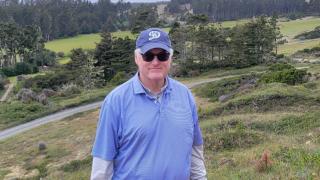

Not too long ago, this avid skier, hiker and golfer faced a grim future. His body was pummeled by a Stage 4 malignancy attacking multiple areas, from his bones to his lungs. Several powerful drugs, including some of the latest, leading-edge immunotherapies, had failed to stop it.
His doctors said they had nothing further to offer. But a handful of institutions — including City of Hope — were trying something brand new.
“If it hadn’t worked,” said City of Hope medical oncologist Yan Xing, M.D., “he’d be in hospice by now.”
Instead, his latest scans show no evidence of disease.
A long scar on the back of his right hand hints at what he’s been through.
Herich, 68, and his wife Arlene make their living building their customers’ dreams. They operate a company that designs and constructs luxurious homes in Sun Valley, Idaho. It’s a family business with deep roots: Ken’s grandfather was an “Old World master carpenter” and his father was a contractor. Growing up in Southern California, Ken was drawn to the craft. He studied architecture in Italy, received degrees in architecture and construction management, then worked in Newport Beach before ultimately relocating to Idaho.
Spending so much time outdoors can carry risks, especially skin cancer, caused by sun overexposure. Mindful of that, Herich made sure to get regular skin checkups at his dermatologist. When a growth appeared on Herich’s hand, his doctor dismissed it, even after a biopsy, saying only that there were “some cells we should keep an eye on.”
“I watched it grow for ten years,” said Herich, ruefully.
Then, one evening, an old friend — a retired physician — noticed Herich’s hand.” “This is melanoma!” he said with alarm.
The mere mention of the word can frighten people.
Melanoma is the rarest form of skin cancer; it affects the cells that give skin its tan pigment. It is also the most lethal skin cancer because of its ability to spread. Approximately 8,510 people in the U.S. are expected to die of melanoma in 2026, according to the American Cancer Society.
A Startling Melanoma Diagnosis
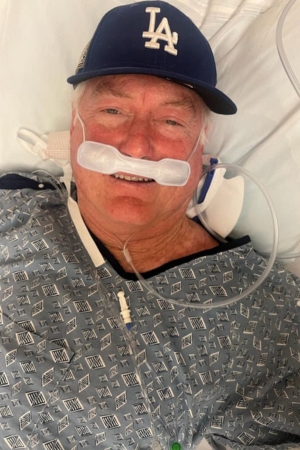
At first, doctors believed Herich’s melanoma was “in situ” — that it went no further than the spot on his hand, and that surgery would take care of it. In mid-2019 they did a “silver dollar-sized incision,” ensuring, they felt, clear margins all around. They also checked nearby lymph nodes, also clear. A week later, Herich received a skin graft reconstruction and thought “it’s all gone.”
It wasn’t.
During a 2020 vacation in Europe, Herich spotted lumps under his right armpit. A needle biopsy confirmed the melanoma had returned and metastasized. Surgery would no longer be enough; it would need to be followed by a long course of immunotherapy.
When surgeons took a closer look, they found “a massive amount of melanoma,” recalled Herich. They reworked their plan, scheduling Herich for six weeks of radiation, five times a week, to be followed by the immunotherapy drug Keytruda®, which he would take for a year.
It seemed to work. In April 2023, he appeared to be cancer-free. And it wasn’t as hard as he’d expected.
“I had minimal side effects from the radiation and the Keytruda,” he recalled. “It didn’t slow me down. I actually thought I was cheating!”
He later found out that this may have been a bad sign, an indication that his body wasn’t fully responding, which meant the cancer could return yet again.
But for now, he was joyous and he had plans involving his daughter Alysha.
“I’m ringing the bell, I’m outta there, everyone’s happy for me,” he remembered. “We celebrated my NED status and her completion of her first year of medical school in May 2023 by picking her up in the parking lot after her last final, driving to the airport, and spending two weeks in Switzerland, Italy and Finland.”
The joy rapidly turned to pain and loss. Twice.
In July, following a difficult breakup, Alysha tragically took her own life. Her loss shattered Ken and Arlene. He still cries when thinking about it now.
“It makes no sense and it never will,” he said. “Life was irreparably, horribly altered for us both, forever.”
“I thought I no longer had a purpose in life,” echoed Arlene.
Melanoma Turned to Stage 4
Then, in January 2024, scans detected new evidence of disease. Ken’s melanoma had spread to his abdomen, and it was now Stage 4.
In February, his doctors tried the next line of treatment: a combination of the immunotherapy drugs nivolumab and relatlimab. Again, he experienced minimal side effects, likely because the treatment wasn’t working. His next scan, in April, showed the melanoma advancing, with signs of cancer on one shinbone, and approaching his lungs.
His oncologists were out of options. But they told Herich that the Food and Drug Administration had just approved a new immunotherapy treatment called Tumor Infiltrating Lymphocyte (TIL) therapy, and that City of Hope was using it.
“Your body makes immune cells (to fight cancer),” said surgical oncologist Vijay Trisal, M.D., who is also City of Hope’s Chief Clinical Officer. “Just not enough. Cancer tends to overwhelm them.” With TIL, surgeons go directly into the tumor and “harvest” the cancer-fighting lymphocytes (also called white blood cells), which are sent to a lab to be multiplied into much larger numbers – billions of them. That new, larger batch of cancer-killing cells then gets re-infused back into the patient.
While the lab does its work, the patient is prepped with intense chemotherapy to burn out existing white blood cells (“Your white count will go down to near zero,” said Dr. Xing). This creates a space for the new, lab-treated cells.
After the re-infusion, patients receive high dose interleukin-2, a growth factor, to help the lymphocytes multiply even further. The entire process can take six weeks or longer.
Some patients, already weakened by multiple rounds of cancer treatments, are not good TIL therapy candidates because they can’t tolerate the necessary chemo and IL-2. But Herich was in relatively good shape; Dr. Trisal called him “the strongest (TIL) patient I’ve had,” and as he extracted Herich’s tumor cells, he let his optimism show, telling Herich, “I think this might cure you!”
Not that it was easy. The chemo and IL-2 “just about killed me,” recalled Herich. But his new massive army of lymphocytes (it was a bit smaller than it should have been, but big enough, in the eyes of City of Hope’s Tumor Board) did the job. Three months later, in February 2025, scans showed the cancer in retreat. “Things were shrinking, things were going away, and some things were no longer evident at all!” he said. And now, nearly a year since his treatment, there is no sign of the melanoma returning.
His doctors are pleased and, quite frankly, amazed.
“Ken is in the five percent of TIL patients who’ve shown a complete response,” said Dr. Trisal.
“Ken’s one of the lucky ones,” added Xing. “I’m very happy for him.”
He knows how lucky he is.
“I’m amazed that it worked so well,” he says. “And I am very, very impressed with City of Hope, with their level of care and the quality of their people.”
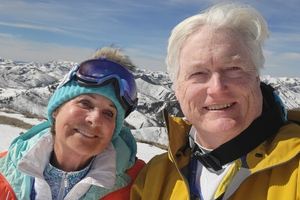
And he wasted no time. Four days after leaving the hospital, Herich sent his doctors a photo from Idaho.
With his wife by his side, as she was through the entire journey, he was back on the slopes.
If you or a loved one is concerned about possible signs or symptoms of cancer and would like an initial appointment or a second opinion, call us 24/7 at (833) 902-5220.