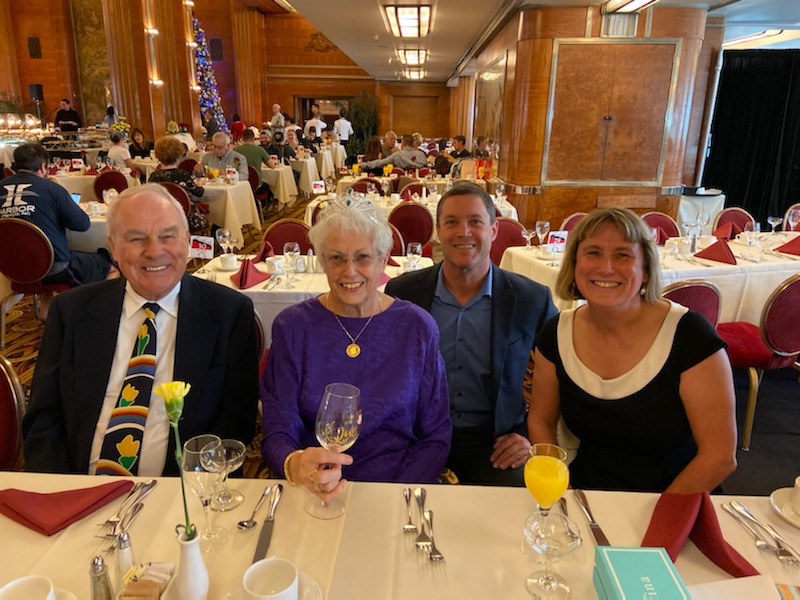
Between 2012 and 2014, lightning struck Dave Edmonds’ family twice. First, doctors determined his wife Sylvia had chronic lymphocytic leukemia (CLL). Then, two years into her treatment, his son Neil received the same diagnosis.
“My wife’s doctor at the time said it was rare to have CLL impact two people in the same family,” Dave said. “It was rare, but it wasn’t an unknown possibility.”
Having the same disease affect his wife and son was devastating. It set the family on a course to secure the best research-based health care available. Their journey led them to City of Hope® and Tanya Siddiqi, M.D., the medical director of lymphoma at City of Hope Orange County who also serves as director of the Chronic Lymphocytic Leukemia Program at the Toni Stephenson Lymphoma Center on the Duarte campus.
An Unexpected — and Aggressive — Disease

Doctors in Southern California discovered Neil’s disease during a hernia evaluation — two golf ball-size lymph nodes turned out to be CLL. CLL is a slow-growing blood cancer that develops when bone marrow creates too many white blood cells called lymphocytes.
At the time, Neil showed no symptoms. His care team adopted the watchful waiting approach and kept close tabs on disease progression. For two years, he remained mostly asymptomatic. But that changed dramatically in 2016.
“Suddenly, my CLL became extremely aggressive. It came on very, very rapidly within a couple of months, and I started to become symptomatic,” he said. “All hell broke loose. So, I went forward with traditional chemotherapy. But I ended up in a medically induced coma and lost half a lung.”
Once Neil recovered, he and his family decided to pursue more expert care. They turned to Sylvia’s oncologist in Northern California for advice.
“At 46, it was clear I needed to be more proactive about seeking out advanced treatment options,” Neil said. “I talked with my mother’s oncologist. Without hesitation, she said I needed to be at City of Hope. That’s how I became connected with Dr. Siddiqi.”
Together, they discussed his treatment options. The Edmonds family learned Dr. Siddiqi is working toward new CLL medications and treatments, as well as investigating if CLL may be genetic.
“It was clear to our family that Dr. Siddiqi’s work is the future of hematology and CLL care,” Dave said. “To support her efforts, we decided together to contribute to her research.”
So, not long after Sylvia passed away in 2022 from heart failure related to her cancer treatment, the family pledged a $1 million gift. It provides $250,000 annually to support Dr. Siddiqi’s efforts.
The Future of CLL Research and Treatment
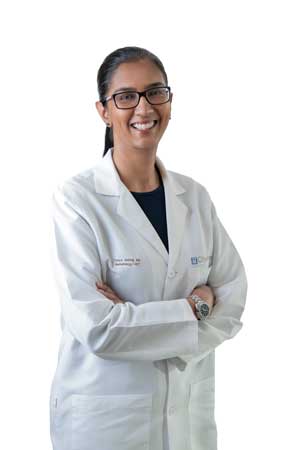
Dr. Siddiqi and her team have been CLL research leaders for several years. Together, they enrolled the largest number of patients for the first national, multicenter CLL clinical trial. Based on their contributions, the Food and Drug Administration approved the first CLL CAR T cell therapy — lisocabtagene maraleucel, also known as Breyanzi.
Funding from the Edmonds family enables Dr. Siddiqi and her team to push their efforts further. Much of the work will focus on the next generation of CLL therapies, she said.
“We don’t really use chemotherapy at all in CLL treatment anymore. Instead, we concentrate on all newer drugs,” she said. “We’re putting our efforts toward targeted therapies, immunotherapies or a combination of them all.”
Additionally, her team plans to use City of Hope’s expansion into Orange County as a springboard to increase access to CLL care. In collaboration with Amrita Krishnan, M.D., executive medical director of hematology at City of Hope Orange County, Dr. Siddiqi conducts outpatient stem cell transplants for patients at this site. The next step, she said, is making the CAR T cell therapy available in the same outpatient setting for CLL, lymphoma and myeloma.
“We’ve been working on this for the past six to eight months,” she said. “Our goal, beginning in the first quarter of 2025, is to bring our outpatient CAR T cell therapy here. This gift will strengthen our ability to make this endeavor a reality.” Ultimately, the plan is for next-generation CAR T trials to be brought to City of Hope Orange County.
To help other families like the Edmonds, Dr. Siddiqi also works with City of Hope systems biologist Lili Wang, M.D., Ph.D. They are exploring whether CLL could be an inherited disease.
“We will use some of the Edmonds’ gift to examine patient samples for any biomarkers that could be predictive,” she said. “If we find these markers, we may be able to identify which patients could develop the disease or determine the targeted therapies that may work best for them.”
Creating a Legacy
As of January 2025, Neil is still in remission from the chemotherapy he received in 2016. But CLL, like other lymphomas, inevitably returns. When it does, Dr. Siddiqi is ready to deliver the most appropriate targeted therapy.
It’s that ability — rooted in evidence-based research — that Dave and his family want to see flourish. It has the potential to improve countless lives.
“We’re not a rich family, but it was within our power to contribute to these efforts that may save other people,” he said. “Dr. Siddiqi will be the partner in helping those families. Supporting her research is something I know Sylvia wanted.”