March is Colorectal Cancer (CRC) Awareness Month, and there is no better time to highlight the work City of Hope is doing to combat this disease. While advances in screening and treatment have contributed to a decreased incidence of CRC, it remains the third most commonly diagnosed cancer in men and women, as well as the third leading cause of cancer death, excluding skin cancer. It is of utmost importance that we utilize every advantage possible to treat CRC, and as a National Cancer Institute-designated comprehensive cancer center with a focus on treatment, research and care of cancer, City of Hope is perfectly positioned to both discover these advantages and integrate them into treatment to deliver world-class results.
As one of only a few centers in the nation treating CRC at every stage of the disease, City of Hope has received national recognition for more than a decade as a high performing hospital for CRC surgery by U.S. News & World Report.
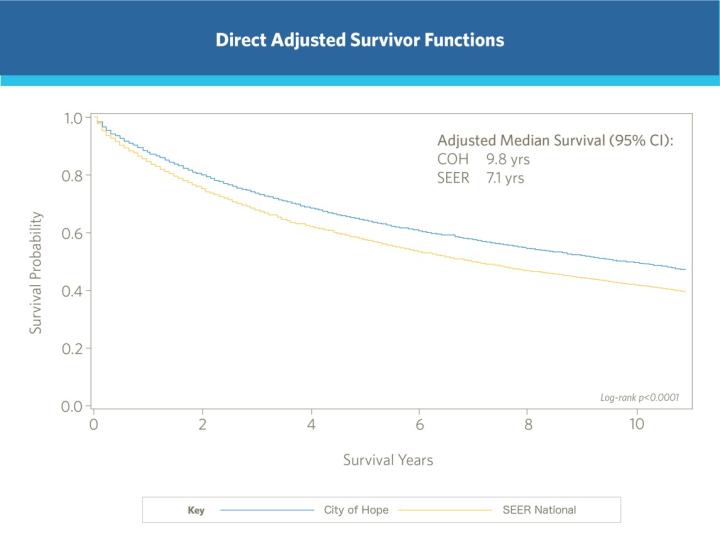
The CRC program is equipped with state-of-the-art diagnostic tools, technology and treatment options for CRCs, including colon, rectal and anal cancer at every stage. Our dedicated CRC physicians and surgeons take pride in their ability to tailor individualized treatment approaches for each patient. It is this personalized approach combining our world-class research with the latest technological advances that has led to City of Hope’s survival for CRC exceeding the SEER National averages at all stages.*
*Based on SEER National Data
City of Hope Colorectal Cancer Adjusted Overall Survival vs SEER National (2007-2016)
Proportional hazards regression adjusting for age (75+, 65-74, 55-64, 45-54 vs 14-44), gender (M vs F), race (Black, other vs white), and Stage (II/III/IV vs 0/1)
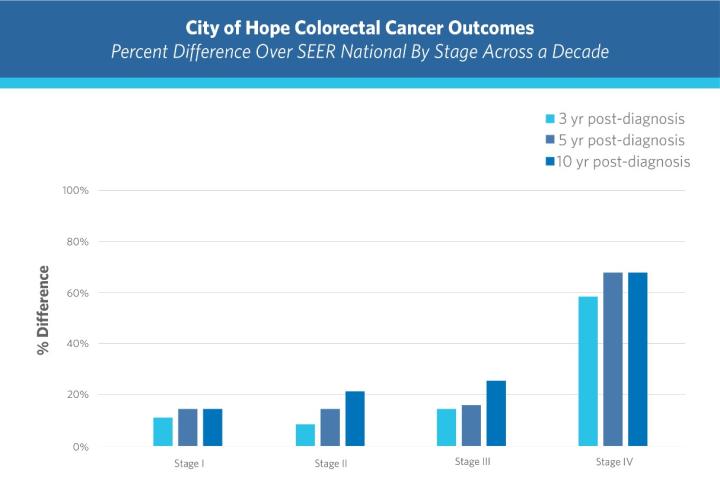
City of Hope stage IV survival is 67% greater than the SEER National average five and 10 years postdiagnosis
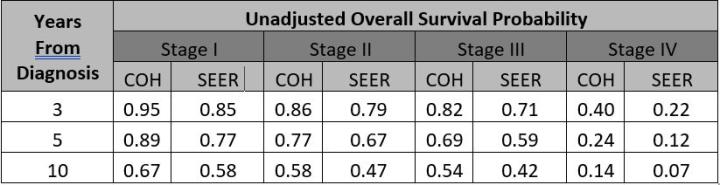
The unadjusted survival probabilities for City of Hope CRC patients across all Stages (I, II, III and IV) were compared to the SEER† National data at three, five and 10 years after diagnosis. The percent difference after five years was ≥14% at all stages of cancer, with the largest differences seen in Stage IV patients regardless of year (3 yr: 58%; 5 yr: 67%; 10 yr: 67%).
†Data were derived from the City of Hope Cancer Registry (CNeXT) and SEER November 2019 Research Data Files as the comparator. All City of Hope patients in Duarte were diagnosed from 2007 through 2016, and the City of Hope follow-up cut-off date was 12/31/2017, to align with SEER data. Survival time was based on first occurring CRC diagnosis during the time period of interest.
The National Cancer Institute’s Surveillance, Epidemiology and End Results (SEER) Program
An authoritative source on cancer incidence and survival, the SEER Program provides cancer statistics to reduce the cancer burden among the U.S. population. It is supported by the Surveillance Research Program, which provides national leadership in cancer surveillance using analytical tools and methodological expertise in collecting, analyzing, interpreting and disseminating reliable population-based statistics.
Our commitment to treating CRC starts with screening. CRC is one of the most curable cancers, yet research shows tens of millions of people are skipping out on lifesaving screening. At City of Hope we are dedicated to increasing the number of lifesaving screenings for CRC. To support that effort, we offer colonoscopies, stool DNA testing and genetic screenings.
In addition, our innovative diagnostic and treatment options include:
Precision surgery based on optimal diagnostics and state-of-the-art technology to safely remove cancer using a minimally invasive approach — this ensures the highest possible chance of curing and preserving natural bowel function
Sacral nerve stimulation (Interstim)
A precision oncology tumor board that systematically screens malignancies leading to referrals for targeted therapies to rare genomic alterations such as HER-2, MSI, BRAF-V600E and KRAS G12C
City of Hope’s Division of Clinical Cancer Genomics Cancer Screening & Prevention ProgramSM also offers a comprehensive cancer risk assessment to determine a patient’s risk of carrying a mutation that predisposes them to cancer
A selective “watch and wait” approach without surgery for suitable rectal cancer patients who show a complete tumor disappearance after routine chemoradiation alone
Immunotherapies and advanced radiation treatment options
Groundbreaking Research Advances Care
Our ongoing research is one example of how we blend the best of academics and medical care within a biotechnology environment — a concept we call the “R&D hybrid” model. The model is designed to speed discoveries to patients by fast-tracking the commercialization of potentially life-changing new therapies.
This model enables us to operate nearly 1,000 clinical trials annually, enrolling 1 in 4 patients.
Andreas M. Kaiser, M.D. Professor and Chief, Division of Colorectal Surgery
Andreas M. Kaiser, M.D., is chief of the Division of Colorectal Surgery in the Department of Surgery. With extensive experience in every aspect of even the most complex colorectal diseases, as well as interdisciplinary treatment in the management of colorectal and anal cancer, hereditary colorectal cancer, inflammatory bowel disease, acute diverticulitis, functional disorders of the colon and rectum, and benign disorders of the anus, he has become a referral center for challenging cases.
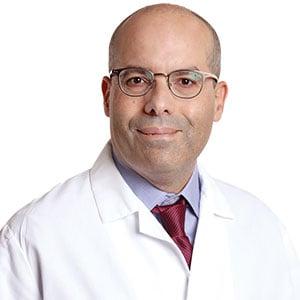
Marwan G. Fakih, M.D. Co-director, Gastrointestinal Cancer Program Director, Clinical Research Unit
Marwan G. Fakih, M.D. has been a key member of the City of Hope team since 2012. He currently co-directs the Gastrointestinal Cancer Program and is the Judy & Bernard Briskin Distinguished Director of Clinical Research. Fakih is passionate about educating his patients every step of the way. A prolific publisher, he has authored over 200 papers and led numerous clinical trials, many of which focus on new treatments for advanced colorectal cancer.
To enroll a patient to a clinical trial, please call 626-218-1133 or visit /research/find-a-clinical-trial for additional information about clinical trials at City of Hope.
Subscribe to our CancerCenter Newsletter
Thank you
Keep an eye on your inbox for the latest City of Hope news and research breakthroughs. If you have previously subscribed to receive email communications, your preferences have been updated.