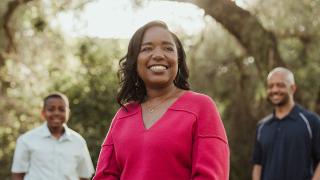
When breast cancer survivor Kommah “Koko” McDowell noticed she was losing track of her thoughts and misplacing her words, she thought she was just being absent-minded. She soon realized, however, that her short-term and long-term memories were being impacted by chemotherapy.
“If you’ve ever seen 50 First Dates with Adam Sandler and Drew Barrymore, then you’ve met my alter ego, 10-Second Tom,” says McDowell. “Tom is a character who can only remember things for 10 seconds at a time. And let’s just say, my family has lovingly nicknamed me ‘Tom.’”
Patients often call moments like these “chemo brain,” which cancer experts refer to as cancer-related cognitive dysfunction. Research suggests several potential causes, ranging from drugs used in cancer treatment to other health conditions or other medications the patient may be taking, to the mental and emotional impacts of navigating a cancer diagnosis.
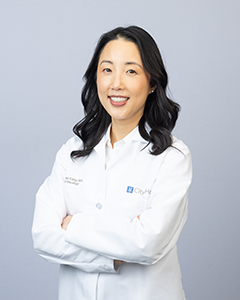
“Cognitive symptoms are always troubling to experience, but some patients may not even mention them to their family or care team,” says Irene M. Kang, M.D., the medical director of women’s health medical oncology at City of Hope Orange County. “It’s important to know there is no reason to be embarrassed about experiencing chemo brain and to communicate with your loved ones and physician if mental changes are affecting your daily activities.”
For McDowell, who was diagnosed more than 19 years ago with an aggressive form of breast cancer, planning ahead is key to keeping on top of her busy career and family life. “Being very aware of my chemo brain, I’ve had to be extra intentional about staying organized,” says McDowell, “In my work as a director of operations, I like to think of myself as the conductor of a large orchestra, managing 10 campuses each with unique needs, overseeing teams across the state, and coordinating groups both nationally and internationally. I can’t afford to let chemo brain take the lead. So, I’m diligent about documenting everything and using technology to keep me on track and ensure I lead my teams effectively.”
McDowell offers these practical tips for managing cancer-related memory issues:
- Give yourself some grace. “You are not alone. Your thoughts really did just vanish out of nowhere, and that’s perfectly okay,” McDowell says. “And yes, it’s okay to see yourself in a photo and not remember the experience.”
- Keep a journal. “Note-taking has become essential for me to record when cognitive issues arise and what is going on at the time.”
- Accept — or even embrace — your new normal. “Embracing chemo brain has taught me to live life to the fullest in every moment,” says McDowell. “I’ve learned to truly savor the small joys in each day because there’s no guarantee I’ll remember them down the road.”
- Be able to laugh about things you cannot control. “I have found that laughter is a vital part of my healing, and those around me agree.”
- Lean on trusted relationships for support. “Trust is essential for my recovery, especially with chemo brain, because it’s my loved ones that help me when I have difficulties.”
Through her advocacy and her writing, McDowell hopes to bring comfort and resilience to patients struggling with side effects of cancer. “Chemo brain isn’t an excuse; it’s a hurdle I have to clear every single day. Photos mean the world to me — they're proof of memories I don’t recall. But in a way, it’s made me better. It forces me to pay close attention to the details and trust the systems I’ve put in place to safeguard myself.”
And on the days when memory fails her? “I ask myself one simple question: What would Koko do? And then I do exactly that."
Also read:
What you need for a chemotherapy care kit
Talking Hope: My story of Hope and possible impossibles: Meet breast cancer survivor Kommah McDowell
City of Hope Orange County Celebrates Survivors, Receives Key to New Cancer Hospital