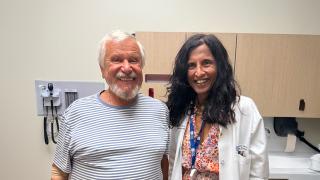
Biochemist Sergei Barbashov, 70, had no hesitation when City of Hope Orange County’s Amrita Krishnan, M.D., recommended aggressive treatment for his multiple myeloma. “I clearly understood that she had a profound expertise and that she's a renowned multiple myeloma specialist,” he said of Dr. Krishnan, the executive medical director of hematology at City of Hope Orange County and the Nason-Hollingsworth Chair in Multiple Myeloma at City of Hope.
“I was ready. I started my research career in molecular biology, so I was prepared,” said Sergei of the treatment. “I knew that it's a very serious disease, and I knew there were modern approaches for treatment of different types of cancer, including multiple myeloma.” He also knew that City of Hope is one of the largest and most advanced cancer research and treatment organizations in the United States. City of Hope conducts more than 700 cancer-focused clinical trials each year, more than anywhere else in California.
That was in 2021 and Sergei’s readiness, grounded in his confidence in science, has remained strong in the last five years since he was diagnosed with cancer.
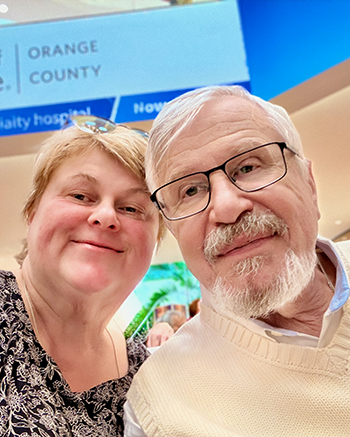
Sergei’s first symptom was a pain in his neck that was getting worse. He and his wife Irina, residents of Irvine, hoped an orthopedist could remedy the pain, but instead, that doctor broke the news of cancer in Sergei’s vertebrae. An MRI revealed multiple lesions in his bones, and Sergei knew immediately his condition was serious, a shocking him and his family.
“When Sergei was diagnosed with multiple myeloma, it felt like lightning out of a clear blue sky,” said Irina. “He had always taken exceptional care of his health, and we thought he was the healthiest person we knew. The diagnosis was unimaginable.”
His cancer was aggressive and Sergei’s condition worsened. “I had pain everywhere. I was using a walker and I was miserable. I couldn't get into the car by myself,” Sergei said, and needed help just to stand and walk.
His first treatment under Dr. Krishnan’s care was a monoclonal antibody therapy called daratumumab, which decreased the pain immediately. “I started getting better and better day by day,” said Sergei. “I went from using a walker to riding a bicycle again. I got my life back.”
Dr. Krishnan guided Sergei through several complex stages of treatment, including proteasome inhibitors, immunomodulators, and radiation therapy. She then recommended an autologous stem cell transplant, an advanced option that uses a patient’s own healthy stem cells to treat certain kinds of cancer. Sergei’s daughters registered to donate platelets for the procedure. The results were positive, and for about a year after the stem cell transplant, Sergei was in remission.
Something else happened too: his and Irina’s priorities began to shift. “Don't delay anything for tomorrow,” Sergei said, explaining their new outlook. “If you can do something today, it's better to do it today. “Life is short. What will happen tomorrow, nobody knows.”
Irina said, “We stopped waiting for ‘someday.’ We value every day in a way we never did before.”
Two years ago, the cancer returned. Sergei again was ready, “My next line of defense was CAR T cell therapy. It went pretty smoothly,” he said, adding that he worked at his job remotely with his computer, which Irina confirmed. “During CAR T therapy, he continued joining scientific conferences and laboratory meetings by Zoom,” she said.
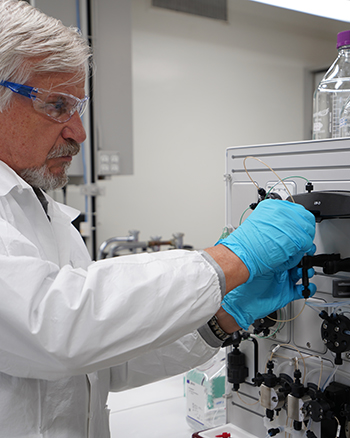
With the objectivity of a scientist, Sergei is impressed by this new treatment. “The whole idea is tremendous, that your own immune cells attack bad cells, either myeloma, lymphoma or whatever. It’s really great, and it came from fundamental science to clinic. The major point is that it destroys bad cells.” Sergei received his doctorate at M. V. Lomonosov Moscow State University, and worked as a scientist in Japan, later at Harvard Medical School, and then for biotechnology companies.
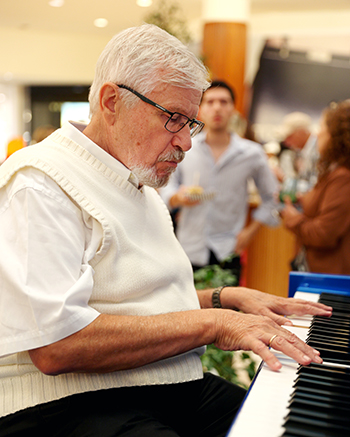
Today, Sergei is monitored regularly and rides his bicycle twice a day and swims almost every day. He enjoys listening to classical music and plays piano. He was surprised on his 70th birthday when Edward S. Kim, M.D., the physician-in-chief of City of Hope Orange County and deputy physician-in-chief of City of Hope National Medical Center, introduced him to a crowd of thousands gathered for a concert at Great Park in Irvine and the Pacific Symphony led everyone in singing happy birthday to him.
In the spirit of “don’t delay,” Sergei and his family have taken trips to Norway to see the northern lights and to Iceland, Japan, France, and Germany — travel that was only possible due to his successful treatments at City of Hope.
“When it seemed that we might be reaching the end, they gave us a chance to keep living, traveling, working, listening to music, and being together as a family,” said Irina.
Sergei is deeply appreciative of the care he’s received over the last five years. “I am profoundly thankful to the entire staff at City of Hope for their exceptional professionalism, compassion, and uplifting attitude throughout my treatment,” said Sergei. “Most of all, I am deeply grateful to City of Hope and Dr. Krishnan. Her profound understanding of this disease and her extraordinary guidance have had a tremendous impact on keeping me stable, healthy, and in good shape.”
Sergei still works as a scientific consultant in biotechnology and continues contributing to the development of future cancer therapies. One of the greatest gifts of his recovery, his family said, has not only been the chance to keep living, but also the opportunity to help move the fight against cancer forward.
“Perhaps that is the happiest ending any scientist could hope for,” said Irina.
Ending Cancer Starts with Hope. To make an appointment at any of City of Hope’s Orange County locations, call 888-333-HOPE (4673).
CAR T vs. Stem Cell Transplant: Understand These Lifesaving Treatment Options for Blood Cancer
Talking Hope: Blood cancer breakthroughs bring new hope to patients
For Patients with Blood Cancer, A Promise Fulfilled