Adaptive Radiation Therapy in Los Angeles and Orange County
At City of Hope® Cancer Center Duarte and City of Hope Orange County Lennar Foundation Cancer Center, patients may receive adaptive radiation therapy as part of their cancer treatment care plan.
What Is Adaptive Radiation Therapy?
Real-time adaptive radiation therapy (ART) is an advanced technique used in cancer treatment that allows radiation plans to be adjusted based on changes in a patient’s anatomy over the course of treatment. These changes might include tumor shrinkage, shifts in normal organ position or weight loss. By adapting the treatment plan to reflect these changes, ART aims to improve the precision and safety of radiation delivery.
When using adaptive radiotherapy, the care team makes necessary adjustments in real time (while the patient is on the treatment table) or between radiation therapy sessions to optimize radiation delivery to the tumor and minimize radiation to sensitive normal tissue and organs. This is often necessary when there is significant day-to-day variation in tumor position and size or when significant day-to-day motion of the surrounding normal tissue (stomach, small bowel, rectum, trachea, esophagus, etc.) This personalized approach ensures precise tumor targeting and allows for the optimization of treatment effectiveness while reducing side effects.
How It Differs from Conventional Radiation Therapy
In conventional radiation therapy, a treatment plan is created using imaging obtained during a mapping session. This plan is then used for the entire course of treatment, which may span several weeks. However, the body is not static — tumor and surrounding organs can move or change shape between sessions.
Adaptive therapy addresses this by:
- Imaging the patient daily to assess any anatomical changes
- Adjusting the radiation plan while the patient is on the treatment table if significant changes are detected
- Delivering radiation based on the updated plan, rather than relying on the original
This approach can be especially important when treating tumors located near sensitive organs or in areas of the body that are prone to daily anatomical changes, such as the chest, abdomen or pelvis.
Benefits of Adaptive Radiation Therapy
The primary goal of ART is to improve the accuracy and effectiveness of radiation treatment. Some key benefits include:
- Improved targeting of the tumor, even as it changes in size or position
- Better protection of healthy tissues and organs, which may shift during treatment
- Potential for higher radiation doses, which can enhance treatment efficacy while minimizing side effects
These benefits are particularly relevant for patients receiving stereotactic body radiation therapy (SBRT), a treatment that delivers high doses of radiation in a small number of sessions (up to five). Because SBRT requires a high degree of precision, real-time ART can help ensure that each dose is delivered safely and as effectively as possible. By adapting the plan daily, clinicians at our Duarte and Orange County cancer centers can safely deliver higher doses per session, which may reduce the total number of treatments needed. Additional benefits could include more convenience, reduced time away from daily activities and potentially faster symptom relief.
How City of Hope’s Care Team Determines Whether ART Is Right for You
Not all patients require adaptive radiation therapy, but it may be recommended if:
- Your tumor is located near sensitive organs.
- Your anatomy is likely to change during treatment.
- You are receiving SBRT or a short-course radiation regimen.
The most common types of cancers that may benefit from ART include pancreatic, liver, and prostate cancer. If a limited spread of cancer is found near sensitive organs, that may be treated with SBRT.
Your radiation oncologist will discuss whether adaptive radiation therapy is appropriate and beneficial for your specific diagnosis and treatment goals.
What Sets Our Adaptive Radiation Therapy Care Apart?
At City of Hope’s Duarte and Orange County hospitals, radiation oncologists may recommend either of the following two advanced systems to deliver adaptive radiation therapy. Both systems are designed to enhance the safety and effectiveness of radiation therapy by ensuring that each treatment session is based on the most current information about the patient’s anatomy. Having both CT- and MR-based adaptive radiation therapy delivered under one department is unique, positioning our radiation oncologists to personalize selection of the best technology to treat a patient’s individual case while offering disease-specific expertise.
Ethos™ Therapy System (CT-Guided With AI Support)
At City of Hope Cancer Center Duarte and City of Hope Orange County Lennar Foundation Cancer Center, our expert team offers the Ethos™ Therapy System, which:
- Uses daily computed tomography (CT) scans to visualize the tumor and surrounding anatomy
- Employs artificial intelligence to assist in identifying changes and generating updated treatment plans
- Performs adaptation quickly, allowing treatment to proceed with minimal delays
CT-based adaptive radiation therapy uses advanced on-board CT imaging incorporated into the linear accelerator for daily adjustments to the treatment plan. The Ethos technology is the only technology that currently allows for real-time CT-based adaptive radiation therapy.
Prostate SBRT Treatment on ETHOS
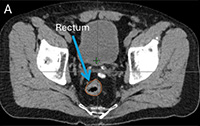
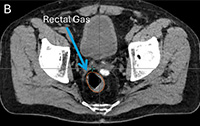
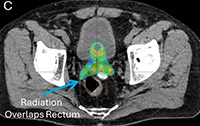
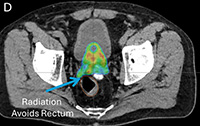
The amount of stool and gas in the rectum may be highly variable. On the day of treatment, this patient was found to have more gas in his rectum that moved the rectum into the high-dose radiation treatment field (A vs. B). Using the adaptive capabilities of ETHOS, his radiation treatment plan was adapted to avoid the rectum (C vs. D).
ViewRay Systems MRIdian® (MRI-Guided with Real-Time Imaging)
At City of Hope’s Orange County location, patients may receive radiation therapy using ViewRay Systems MRIdian®, which:
- Uses daily MRI scans to offer clear visualization of soft tissues for each treatment
- Employs real-time MRI imaging to assist in identifying changes and generating updated treatment plans
- Allows clinicians to use real-time MRI to monitor tumor motion during treatment and pause radiation if the tumor moves out of the target area
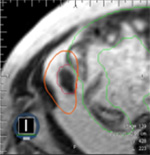
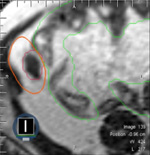
Example of MRI-Guided Adaptive SBRT on MRIDIAN
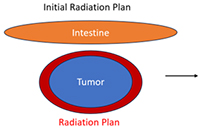
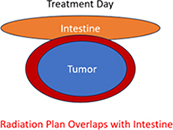
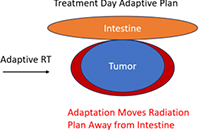
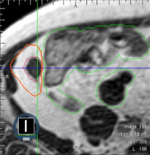
This is a patient with a single tumor in the abdominal cavity. Given its location, the tumor and surrounding large and small intestines move daily in relationship with each other. On the left is the initial treatment plan. The orange line depicts a dose of 35 Gy covering the tumor and avoiding the bowel. The middle image depicts the first day of treatment, showing that the original plan and the 35 Gy high-dose region would overlap a loop of intestine and overdose the intestine given the anatomy of the day. The image on the right shows an updated treatment plan designed while the patient was on the table that adapted to the anatomy of the day such that the 35 Gy high-dose region in orange no longer overlaps the bowel and minimized damage to this region while optimally covering the tumor.
Sparing Bowel from High-Dose Volume
What to Expect During ART at City of Hope
If you are receiving adaptive radiation therapy, your daily treatment routine may include:
- Imaging: A CT or MRI scan is taken before each session.
- Plan evaluation: The care team reviews the scan to determine whether changes are needed.
- Plan adaptation: If necessary, a new treatment plan is created while you are on the treatment table.
- Radiation delivery: The updated plan is used to deliver your treatment.
While this process may add 20-40 minutes to each session, it helps ensure your treatment is as accurate and personalized as possible.
Radiation Oncology Research at City of Hope
City of Hope’s research team is continually evaluating new options for enhancing radiation therapy delivery, visualization and effectiveness.
Learn more about our Los Angeles-area radiation therapy research
Make an Appointment with Our Radiation Oncologists
Please include Duarte Radiation Oncology scheduling number:
Please include Irvine Radiation Oncology scheduling number: